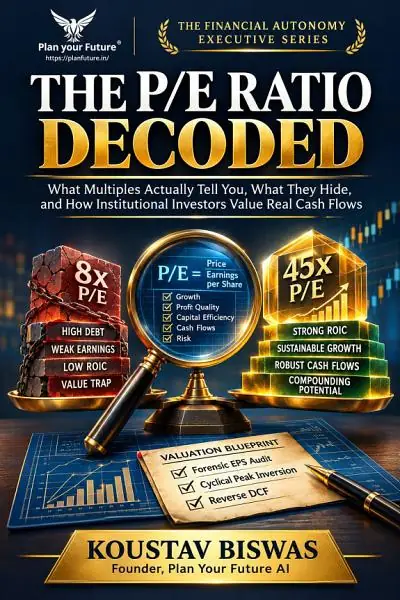
The P/E Ratio Decoded
What Multiples Actually Tell You, What They Hide, and How Institutional Investors Value Real Cash Flows
By Koustav Biswas
₹500 · Google Play list price, before tax
Prices from the author’s Google Books export · 20 November 2026. Amazon prices and store taxes may differ.
About this book
A low P/E ratio does not make a stock cheap. A high P/E ratio does not make a stock a bubble.
Most retail investors screen stocks using a single, dangerous metric: the Price-to-Earnings (P/E) ratio. They buy cyclical commodity companies trading at single-digit multiples right at the peak of an earnings cycle, only to watch their capital collapse by 50% when profits normalize. Simultaneously, they avoid elite compounders trading at 45x P/E, missing out on multi-bagger wealth creation because they mistake a quality multiple for an overvalued stock.
In The P/E Ratio Decoded, investment professional Koustav Biswas deconstructs market valuation multiples through the lens of institutional private equity, forensic accounting, and quantitative corporate finance. This guide cuts through retail screening dogmas to teach you how institutional investors evaluate earnings quality, calculate the market's implied growth expectations, and detect value traps before deploying capital.
What You Will Learn Inside:
The Anatomy of a Multiple & Accrual Earnings Understand the fundamental disconnect between reported accrual net profit (PAT) and real cash generation. Learn how two companies with identical ₹100 EPS numbers can have completely different intrinsic values based on capital intensity, working capital bloat, and cash conversion cycles.
Trailing vs. Forward P/E: The Consensus Revision Trap Why trailing twelve-month (TTM) multiples look in the rearview mirror while forward multiples rely on Wall Street optimism. Learn to calculate the 3-Year Consensus Drift to identify when downward analyst revisions are about to trigger a violent multiple collapse.
The Three Dangerous Retail Fallacies Deconstruct why a low P/E is often a bankruptcy trap, why high multiples are justified by massive total addressable markets, and why evaluating P/E without auditing the company's debt structure guarantees portfolio losses.
Inverting the Multiple: Implied Market Growth Rates Learn how to invert the Gordon Growth Model to calculate the exact 5-year and 10-year Free Cash Flow growth rate the market is pricing into any stock. Determine whether an asset is priced for perfection or offers a margin of safety.
The ROIC Engine & Reinvestment Runway Discover why growth creates shareholder value only when Return on Invested Capital (ROIC) exceeds the cost of capital (WACC). Understand why high-ROIC franchises that reinvest profits back into their business deserve a permanent multiple expansion over low-ROIC dividend payers.
Earnings Yield vs. Sovereign Bond Spreads Equities do not trade in isolation. Learn to compare equity Earnings Yield directly against the 10-year Government Securities (G-Sec) yield to gauge macroeconomic equity risk premiums across interest-rate cycles.
The Debt Mirage & Enterprise Multiples How excessive debt artificially boosts EPS and manufactures low P/E ratios right before debt-servicing crises. Learn when to replace P/E with Enterprise Value to EBITDA (EV/EBITDA) and EV/EBIT to expose capital structure risk.
The Cyclical Peak Inversion (Peter Lynch's Rule) Master the counter-intuitive physics of cyclical and commodity stocks: why they look cheapest at peak earnings and most expensive at the cycle trough. Use mid-cycle normalized earnings to value industrial and metal businesses safely.
Forensic Accounting: Cleaning the "E" Audit corporate filings like a forensic examiner. Learn to strip away exceptional non-operating gains, detect capitalized operating expenses buried inside Capital Work-in-Progress (CWIP), and spot revenue inflation via Days Sales Outstanding (DSO) expansion.
The Institutional Sector Matrix & Reverse DCF Deploy sector-specific valuation metrics for Banks (P/ABV), Real Estate (NAV), Capital Goods (EV/EBITDA), and Tech (EV/Sales). Complete your analysis using a 10-year Reverse Discounted Cash Flow model to solve backward for required cash-flow targets.
Stop relying on one-dimensional screening rules. Start auditing valuation multiples with institutional clarity.
Who this book is for
Investors and traders who want to read financial statements, valuations and price action with discipline.
More books like this
Stock Market & Investing →


Related tools on Plan Your Future
Koustav Biswas · AMFI-registered Mutual Fund Distributor · ARN-194809 · EUIN E389902. Financial product distributor and Authorised Person; not a SEBI-registered RIA or RA. Books are educational learning material, not a personalised investment service. Mutual fund investments are subject to market risks; read all scheme related documents carefully. Investment in equity market is subject to market risk. We do not claim any guarantee of return in equity-related investments. Past performance is not indicative of future results.