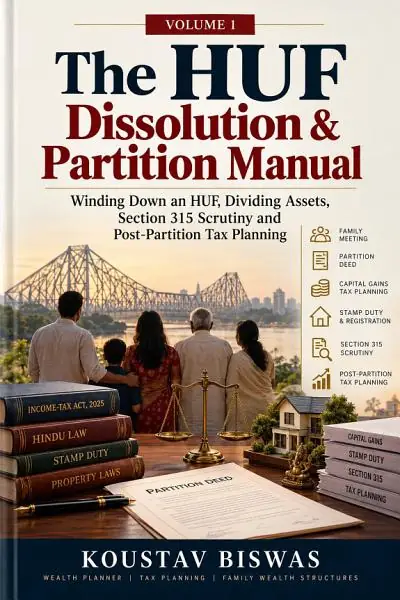
The HUF Dissolution & Partition Manual
Winding Down an HUF, Dividing Assets, Section 315 Scrutiny and Post-Partition Tax Planning
By Koustav Biswas
₹500 · Google Play list price, before tax
Prices from the author’s Google Books export · 20 November 2026. Amazon prices and store taxes may differ.
About this book
Hundreds of guides explain how to start a Hindu Undivided Family. Almost none explain how to end one safely.
When an HUF is divided badly, a family can pay crores in capital-gains tax that never needed to arise, pay stamp duty on assets that never needed a registered deed, and keep receiving tax notices for an HUF that no longer exists in fact. It can also produce a partition deed that a married daughter, a widow or a minor grandchild can challenge years later. When it is divided well, the same partition costs a few lakh rupees, takes about four months, and leaves every member with clean title.
This book follows the Saraf family of Kolkata through a complete ₹18 crore partition. It runs from the first family meeting to the Assessing Officer’s finding under Section 315 of the Income-tax Act, 2025 (earlier Section 171). Every rule is checked against the law in force in October 2026, and every number is recalculated.
What’s inside:
The law since 1956: Mitakshara and Dayabhaga, daughters’ rights under the 2005 amendment, the Vineeta Sharma ruling (2020), and why old oral partitions often fail in court
Full and partial partition: why tax law has not recognised partial partitions since 1978, with a decision tree
How to work out each person’s share, including the wife’s share, a deceased son’s heirs, minors and married daughters
Partition deed, family memorandum or settlement: which document to use for which asset
Stamp duty planning, showing how one family’s bill falls from ₹7.2 lakh to ₹2.4 lakh
The tax rules: why a partition is not a transfer and not a gift, the risk in cash equalisation payments, and clubbing of income
Cost and holding period after partition, with indexation compared against 12.5% tax for later sales
Dividing property, listed shares, mutual funds, private company shares, gold and fixed deposits
The Section 315 inquiry: faceless assessment, what the officer looks for, and the joint liability that remains afterwards
Special situations: a Karta who dies mid-process, NRI members, firms, debts, pending tax disputes
Disputes: mediation, partition suits and time limits
After partition: new smaller HUFs, private trusts, LLPs, wills and nominations
Templates for the deed, the memorandum, the Section 315 submission and letters to tenants, companies and banks
A 120-day timetable, six worksheets and 20 questions to ask your advocate and CA
The book contains 17 chapters, 18 charts and infographics, 22 tables and 24 stories, case studies and worked examples. It also has detailed contents, a page-wise breakdown, a list of figures, a glossary and a data-verification note.
It is written for HUF Kartas, coparceners, inheritors, family-business owners and the chartered accountants and advocates who guide them.
Who this book is for
Working professionals and families balancing EMIs, insurance, tax, children’s goals and long-term wealth.
More books like this
Career & Family (30–50) →
Related tools on Plan Your Future
Koustav Biswas · AMFI-registered Mutual Fund Distributor · ARN-194809 · EUIN E389902. Financial product distributor and Authorised Person; not a SEBI-registered RIA or RA. Books are educational learning material, not a personalised investment service. Mutual fund investments are subject to market risks; read all scheme related documents carefully. Investment in equity market is subject to market risk. We do not claim any guarantee of return in equity-related investments. Past performance is not indicative of future results.