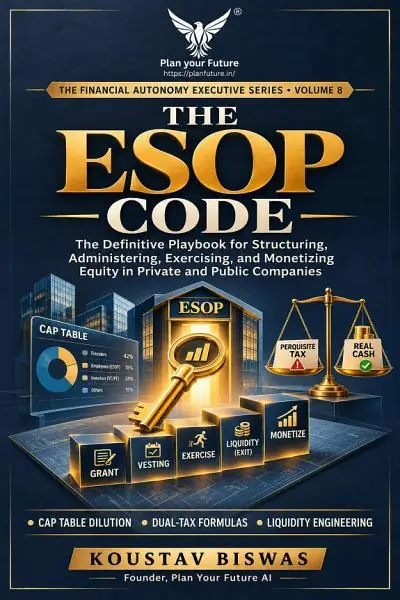
The ESOP Code
The Definitive Playbook for Structuring, Administering, Exercising, and Monetizing Equity in Private and Public Companies
By Koustav Biswas
₹500 · Google Play list price, before tax
Prices from the author’s Google Books export · 20 November 2026. Amazon prices and store taxes may differ.
About this book
Cash pays the monthly bills, but equity creates generational wealth. Yet, for over 90% of founders, human resource leaders, and startup executives, Employee Stock Ownership Plans (ESOPs) remain an opaque, poorly understood labyrinth.
Founders routinely fall victim to the "Option Pool Shuffle," where venture capitalists force existing promoters and early staff to absorb 100% of cap-table dilution before a funding round. Meanwhile, employees and senior executives make life-altering career moves based on empty promises of "100,000 shares"—only to discover that an unannounced pool expansion, stacked liquidation preferences, or punitive 30-day post-termination exercise windows render their paper wealth worthless. Even worse, option holders often face devastating, out-of-pocket perquisite tax bills on private shares they cannot legally sell on an open exchange.
In The ESOP Code, wealth consultant and financial architect Koustav Biswas delivers a comprehensive, institutional-grade manual covering the lifecycle of equity compensation. Written through a practical dual lens, this masterwork equips founders and HR leaders with the legal and governance architecture to build magnetic, retention-driving option pools, while arming employees and executives with the tactical tools to negotiate, exercise, fund, and monetize their equity grants safely.
What You Will Learn Inside:
Cap Table Physics & The Option Pool Shuffle Deconstruct the math behind fully diluted ownership. Learn how to calculate dilution across Seed, Series A, B, and Growth rounds, and discover how venture capital term sheets use pre-money option pool requirements to quietly discount company valuations.
Master Scheme Architecture: Direct Allotment vs. The ESOP Trust Route Compare the operational advantages and regulatory hurdles of direct share allotments under Section 62(1)(b) of the Companies Act versus setting up an irrevocable Employee Welfare Trust to warehouse shares, facilitate secondary buybacks, and protect your cap table from clutter.
Vesting Mechanics, Cliffs & Leaver Protections Design fair, legally watertight vesting rules. Master 4-year schedules with 1-year cliffs, milestone-based performance triggers, and the critical distinction between single-trigger and double-trigger acceleration upon corporate acquisition. Establish unambiguous "Good Leaver" vs. "Bad Leaver" clawback rules.
Valuation Engineering & P&L Accounting (Ind AS 102 / 409A) Understand how private share options are formally valued. Discover the role of Merchant Banker and Registered Valuer certifications in India, navigate US Section 409A appraisals, and learn how the Black-Scholes-Merton model amortizes share-based compensation on corporate P&L statements.
The Dual Tax Events: Perquisite vs. Capital Gains Tax Demystify the exact moments tax authorities claim your wealth. Calculate Stage 1 Perquisite Tax upon exercise (FMV minus Strike Price at ordinary income tax rates) and Stage 2 Capital Gains Tax upon sale. Navigate Section 80-IAC tax deferral benefits for eligible startups and master foreign asset reporting under Schedule FA.
Solving the Cash-Dry Exercise Dilemma What do you do when exercising your vested options requires lakhs or crores of rupees in strike price payments and upfront perquisite taxes without a public market to sell? Explore cashless exercise mechanics, structured non-recourse ESOP financing, and the urgent push for 5-to-10-year extended post-termination exercise windows (PTEW).
Liquidity Engineering & Secondary Sales Learn how growth-stage companies design structured liquidity events before an IPO. Discover the legal framework of secondary tender offers, private equity buybacks, Companies Act buyback thresholds, and minority tag-along rights.
The Public Market Transition (IPO Allotments & SEBI SBEB) Prepare your cap table for the public markets. Navigate SEBI (Share Based Employee Benefits and Sweat Equity) Regulations, pre-IPO statutory lock-in periods, and insider trading blackout protocols (SEBI PIT) for designated employees.
The Executive Playbook: Negotiating, De-risking & Family Trusts Equip yourself to negotiate refresh grants, tax gross-up covenants, and custom acceleration clauses in your employment contract. Avoid the concentration trap of keeping 80%+ of your family net worth in company stock, and learn how to direct equity proceeds into Private Family Trusts to eliminate probate disputes.
Whether you are a founder structuring an option pool from scratch, a board member governing corporate compensation, or an executive planning a multi-crore equity exit, The ESOP Code is your definitive operational blueprint.
5. Google Play Search Phrase Clusters (ASO Optimization)
Cluster 1 (ESOP Basics & Scheme Design): ESOP scheme India, employee stock ownership plan, how to design ESOP pool, ESOP trust route, ESOP vesting schedule 1 year cliff, startup equity compensation, cap table management Carta.
Cluster 2 (ESOP Taxation & Compliance): ESOP perquisite tax calculation India, capital gains tax unlisted shares, Section 80-IAC ESOP tax deferral, 409A valuation startup, SEBI SBEB regulations, Schedule FA foreign assets RSU, DTAA cross border ESOP tax.
Cluster 3 (Exercise & Liquidity Strategies): how to exercise stock options, cashless exercise ESOP, secondary sale unlisted shares, ESOP buyback startup India, post termination exercise window PTEW, ESOP funding non recourse, startup equity liquidation.
Cluster 4 (Executive Negotiation & Dilution): option pool shuffle dilution, fully diluted shares calculation, negotiate executive equity startup, double trigger acceleration clause, good leaver bad leaver ESOP, RSU vs ESOP differences.
Who this book is for
Founders, family-business owners and ESOP holders who want to keep personal wealth separate from the company.
More books like this
Business Owners →



Related tools on Plan Your Future
Koustav Biswas · AMFI-registered Mutual Fund Distributor · ARN-194809 · EUIN E389902. Financial product distributor and Authorised Person; not a SEBI-registered RIA or RA. Books are educational learning material, not a personalised investment service. Mutual fund investments are subject to market risks; read all scheme related documents carefully. Investment in equity market is subject to market risk. We do not claim any guarantee of return in equity-related investments. Past performance is not indicative of future results.